
End-to-end app development is rapidly becoming the standard for teams that want to ship reliable, scalable products without the coordination nightmare. Whether you are a startup or an enterprise, understanding this full-cycle approach to building apps is the first step toward shipping products that actually work.
Table of Contents
Back in the quaint era of 2023, building a mobile app felt wonderfully improvised. You hired a freelance designer, outsourced development to an agency, and let someone’s cousin “handle marketing”. Somehow, things shipped. Mostly.
Fast-forward to 2026 and that same approach produces what can only be described as “Frankenstein apps”. The mobile app design looks polished, the backend barely acknowledges its existence, and every operating system update feels like a jump scare. The cost of this fragmentation is no longer theoretical. 70% of employees lose as much as 20 hours every week switching between disconnected systems, which means your fragmented app development chaos is quietly draining productivity long after launch day.
In a market where speed decides survival, juggling five vendors isn’t flexibility. It’s organised self-sabotage.
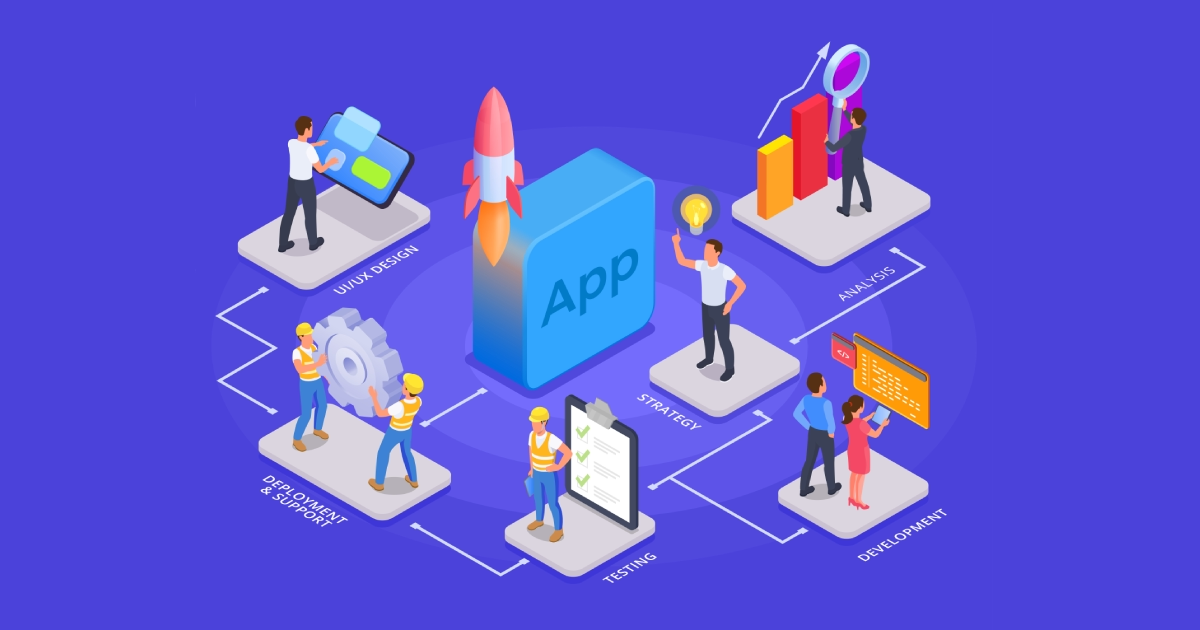
End-to-end mobile app development means one accountable partner owns the full lifecycle of your mobile application, from the first idea scribbled on a napkin to the inevitable post-launch “why is this happening?” moments.
This ownership explicitly includes product discovery, UI/UX design, frontend and backend development, quality assurance, app store deployment (Google Play Store and Apple App Store), and ongoing optimisation and maintenance after launch. It is not just about writing code; it is about managing the entire system from start to finish.
This model eliminates the industry’s favourite hobby: the blame game. When product strategy, design, development, testing, and delivery live under one roof, accountability stops being optional. The full-lifecycle a.k.a single-vendor delivery models consistently reduce integration risk, minimise delays, and lower long-term costs compared to multi-vendor approaches, largely because coordination happens by design, not negotiation.
Forbes Tech Council states that users expect mobile apps to be fast, intuitive, secure, and easy to maintain from day one, and failure in any of these fundamentals directly increases the risk of abandonment and costly rework.
It also makes reacting to change significantly easier. When interface trends shift, as they did rapidly with agent-led interactions in late 2025, integrated teams update roadmaps immediately. This is why end-to-end delivery has become the default for serious products, and why teams like MPiFY focus on building coherent systems rather than managing supplier politics.
In 2026, a mobile application without intelligence is essentially a very expensive pamphlet. AI is no longer an optional feature. It is infrastructure.
Academic research shows that applications designed with AI embedded at both the data and user-experience layers outperform systems where AI is added after development, particularly in agent-driven and task-oriented environments. In other words, intelligence works best when it is designed in, not duct-taped on.This is why hiring a separate “AI person” at the end of a project rarely ends well. Successful AI-integrated end-to-end app development treat UX, logic, and data as one system from day one, ensuring that agentic behaviour feels intentional rather than accidental.
The long-running debate between native and cross-platform development has quietly ended. Not because one side won, but because users stopped caring.
Usage trends show that more than 137 billion mobile apps are downloaded globally in 2024 and the number is expected to grow, while tolerance for poor performance continues to shrink. Users do not ask what framework you used. They ask why your app crashes during a taxi ride.
Modern cross-platform frameworks have matured to the point where most users cannot distinguish them from native builds in everyday use. The real expertise lies in knowing when cross-platform speed is sufficient and when native performance is genuinely required, and making that decision early as part of a complete, end-to-end development strategy.
That judgement is best handled by experienced end-to-end teams, including cross-platform app developers Malta businesses increasingly rely on for scalable, future-proof builds.
One of the most persistent myths in mobile app development is that the work ends when the app goes live. Launch is not the finish line. It is the starting pistol.
Research shows that 89% of business leaders are concerned about chronic software project delivery delays, with post-launch fixes, misalignment, and technical debt playing a major role. Without a structured post-launch process, apps slowly decay through crashes, poor ratings, and quiet user abandonment.
True end-to-end delivery includes post-launch orchestration: monitoring stability, improving discoverability, and iterating based on real-world behaviour. This lifecycle mindset has become central to enterprise mobile solutions 2026, where reliability matters far more than release-day excitement.
Most apps don’t fail because the idea was bad or the technology was weak. They fail because complexity was left unmanaged.
Nowadays, the difference between apps that scale and apps that stall is structure. End-to-end thinking replaces guesswork with clarity, reduces wasted effort, and turns ambitious ideas into products people actually want to keep installed.

If you’re planning your next mobile product, maybe it’s time to stop assembling monsters and start designing systems that simply make sense.
Most apps feel chaotic because they are built by multiple vendors without a single owner. The fragmentation causes hidden productivity loss, with employees losing up to 20 hours a week switching systems.
End-to-end mobile app development puts one team like MPiFY in charge from initial concept and UI/UX design to development, testing, and app store launch. It also includes ongoing maintenance, updates, and optimisation after users start using the app. No more long-term app chaos.
End-to-end delivery reduces delays by eliminating handoffs between disconnected teams. This helps reduce the worries, as 89% of business leaders are already concerned about chronic software delivery delays.
Single-vendor models reduce integration risk and coordination overhead. Over time, this minimises delays and lowers total cost compared to managing multiple suppliers.
AI is now infrastructure, not an optional add-on. MPiFY ensures AI-integrated mobile apps are designed with intelligence built into UX, logic, and data from day one
Cross-platform development meets user expectations for speed and reliability. With over 137 billion mobile apps downloaded globally in a year (2024), users care about performance, not frameworks.
Teams building complex or scalable products benefit most from end-to-end delivery. True end-to-end thinking replaces guesswork with clarity, reduces wasted effort, and ensures apps are actually kept installed.


.svg)
