
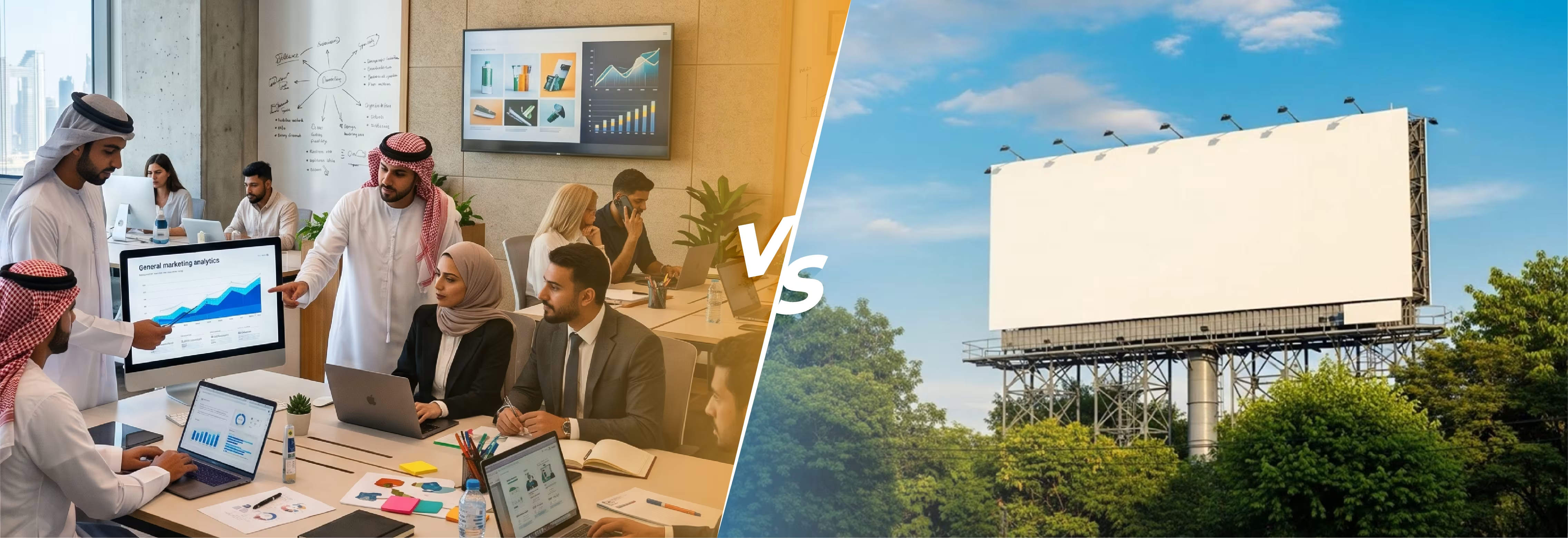
The UAE’s digital ad spend is projected to reach USD 2.64 billion in 2026, growing at 15.2% annually, yet most businesses still rely on marketing frameworks built for a pre-digital era. Companies that want to scale effectively in this environment must partner with a performance-led digital marketing agency UAE to capture online demand and secure sustainable market share.
Table of Contents:
Modern commerce relies heavily on where consumers spend their time and attention. Traditional marketing agencies rely on offline infrastructure like billboards, newspapers, radio, and television broadcasts to reach a broad audience. While these methods generate general visibility, they lack precision. In contrast, a modern digital agency builds tailored ecosystems using search engines, website design, social platforms, and targeted programmatic ads. As of January 2025, the UAE had 99% internet penetration across its entire population, with 11.3 million active social media user identities, equivalent to 100% of all residents. This is not a projection; it is the current baseline that every corporate marketing strategy must account for.
A performance-led digital firm builds measurable online engines designed to convert interest into revenue. The service suite typically includes digital advertising, SEO audit and strategy, content marketing, automation, web design with UI/UX strategy, and conversion rate optimisation. By utilizing deep data pools, these agencies track exact acquisition costs, user pathways, and digital return on investment. This focus on clear numbers ensures that business owners can see exactly how much revenue is generated from every single dirham spent on a campaign. MPiFY delivers exactly this kind of performance architecture for clients across the UAE, EMEA, and Gulf markets, combining SEO and AEO strategy, paid digital advertising, and high-conversion web design under one roof.

Traditional advertising is not dead, but its limitations are increasingly costly in the UAE market. Smartphones now drive 79% of all eCommerce transactions in the country, meaning a billboard or magazine spread cannot intercept buyers at the moment of intent.
Massive creative impact and broad public awareness are the things traditional marketing agencies rely on. Their main tools are physical installations, magazine spreads, and broadcast media that reach a wide demographic simultaneously. This classic method works well for mass-market products that need widespread recognition across the region. However, it struggles to target specific buyers or show immediate conversion data, making it difficult to calculate the exact financial impact of a campaign.
The ability to pivot campaigns immediately based on performance data separates modern digital execution from legacy practices. Traditional campaigns require lengthy printing cycles, contract negotiations, and physical installations that make fast adjustments impossible. MPiFY provides real-time optimisation frameworks that allow brands to tweak ad messaging, adjust audience targeting, and reallocate budgets within minutes of analyzing campaign performance data. This high level of agility prevents businesses from wasting budget on underperforming creative assets or cold audiences.
The case for agility is backed by hard numbers. By end of 2025, more than 70% of marketing budgets in the UAE are allocated to digital channels, driven by real-time behavioural analytics that make traditional campaign cycles obsolete. As Keith Debono Borg, Co-Founder & Managing Director of MPiFY, recently noted, corporate survival in highly competitive regional markets depends entirely on an enterprise's structural agility to shift marketing resources directly toward proven, high-converting digital consumer trends before competitors can react.
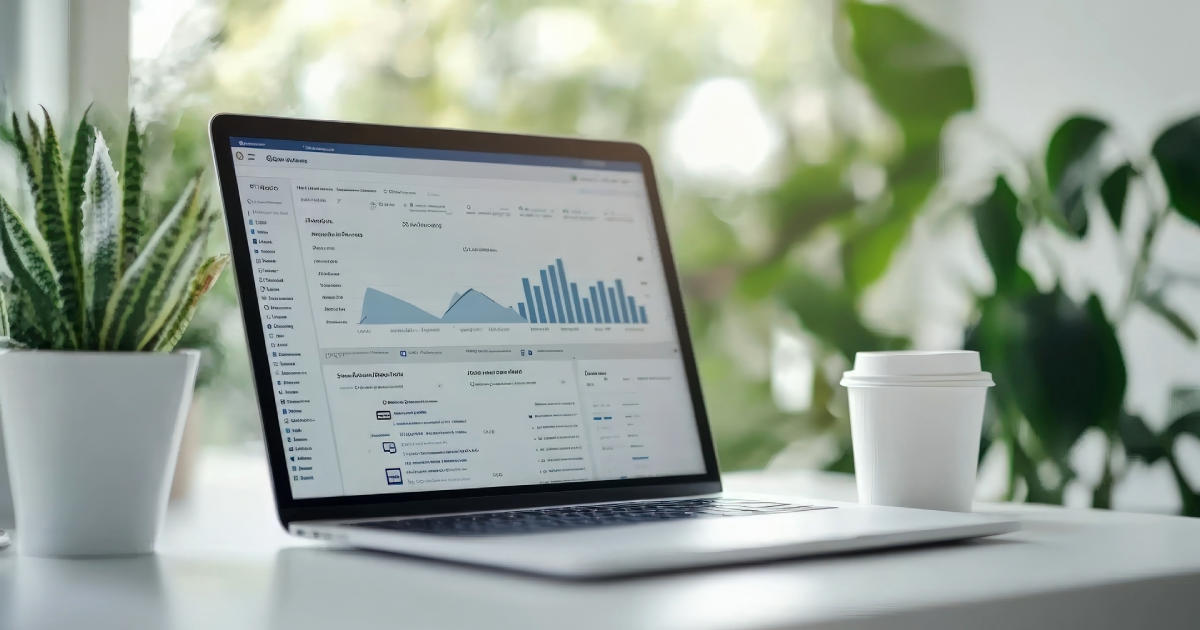
High entry costs have always made large-scale traditional media campaigns difficult for growing companies to access. Broadcast spots and premium outdoor boards require massive upfront capital investments before any audience data is collected. MPiFY removes these financial barriers by engineering scalable digital marketing frameworks that start with lean test budgets and scale up only when profitability is proven. This flexible approach allows companies to mitigate financial risk while collecting valuable behavioral data.
For context, established SMEs in the UAE typically allocate 8% to 12% of annual revenue on digital marketing, while Dubai startups commit 15 to 20%. MPiFY’s scalable frameworks allow businesses to enter these channels at lean test budgets and scale only when performance data proves profitability, significantly de-risking the initial investment.
An enterprise requires precise conversion tools, direct customer engagement, and clear attribution models to grow its market share. The UAE eCommerce market reached AED 32.3 billion (USD 8.8 billion) in 2024 and is projected to surpass AED 50.6 billion by 2029, according to an EZDubai report published via Emirates News Agency. For businesses that want a share of this growth, MPiFY provides the conversion architecture, attribution models, and audience targeting infrastructure needed to compete effectively.
Digital agency MPiFY designs comprehensive online architectures that maximize lead generation, boost digital sales, and strengthen brand presence across the Gulf ecosystem. By focusing heavily on data transparency, businesses get clear visibility into their customer acquisition pipelines.
Is a hybrid approach effective for established brands? MPiFY combines top-tier digital performance frameworks with smart brand building to help companies maximize both broad market awareness and daily online conversions. This balanced approach ensures that short-term sales goals are achieved while building long-term brand equity in the region.
The table below breaks down the practical differences between these two agency models.
Before selecting an agency model, here are the strategic principles MPiFY recommends every UAE business should follow.
The window to capture digital market share in the UAE is compressing fast. With digital ad spend set to hit USD 2.64 billion in 2026 and programmatic buying projected to represent 76% of total digital ad revenue by 2028, brands without a robust online infrastructure will find it increasingly expensive to compete. MPiFY builds that infrastructure, from SEO and AEO to paid digital ads and conversion-optimised web design, for clients across the Gulf, EMEA, and beyond. Ready to scale with a digital marketing agency UAE that delivers measurable results? Get in touch with MPiFY today.

Digital agencies like MPiFY focus entirely on data-driven online channels, real-time optimisation, and measurable conversion tracking, whereas traditional agencies use offline broadcast media to build broad public awareness.
A leading digital agency for UAE market like MPiFY focus on search engine optimisation (including AEO for AI-driven search), paid digital advertising across search and social platforms, conversion-optimised web design, programmatic display, and automated email systems, all integrated within a single measurable performance framework.
Traditional agencies evaluate performance through estimated reach, brand awareness surveys, and post-campaign market analysis rather than exact, real-time sales numbers.
Yes, digital campaigns can be adjusted instantly based on incoming data, allowing brands to change creative assets or shift budgets to maximize performance.
Digital platforms allow companies to launch campaigns with small test budgets and scale spend up gradually as performance data proves profitability.
Digital marketing builds two-way communication through interactive messaging, comments, and direct feedback loops, while traditional media relies on a one-way broadcast message.
Large enterprises often use a hybrid model to build broad brand recognition via traditional channels while capturing direct revenue through high-performance digital campaigns.


.svg)
