


.svg)

No-Code Sounds Easy, Until Your Website Stops Converting
Building a no-code website using a DIY web builder has never been easier, but standing out has never been harder. In 2026, launching quickly is no longer impressive. What matters is whether your site avoids the growing epidemic of identical templates that quietly damage authority, trust, and conversions.
Table of Contents
- What is the 2026 web design phenomenon?
- Is a DIY no-code website damaging the conversions?
- Why can browsers recognise a no-code template?
- The Hidden Cost of a “Free and Easy” No-Code Website
- Beyond the Grid: Why Logic Beats Luck
- Conclusion: A Smarter Alternative to Basic No-Code Builds
What is the 2026 Web Design Phenomenon?
We have reached a tragic point in history where the internet is positively swimming in "digital beige": websites that look, feel, and fail in precisely the same bog-standard way. The question keeping founders awake at night is usually, "Is it actually possible to build a professional website without coding?" While the barrier to entry has vanished, the barrier to looking like a legitimate business has become a veritable mountain. It is a ruthless environment out there. Researchers have found that users form an opinion about your brand’s authority in approximately 0.05 seconds. If your site looks like a carbon copy of a thousand other generic web design websites, your conversion rate is likely already paying the ultimate price.
Is a DIY No-Code Website Damaging the Conversions?
Drag-and-drop builders are absolutely smashing for a hobby blog, but they are often where professional credibility goes to die a quiet death. Consumers in 2026 are hyper-aware; they can spot a template from a digital mile away, and they immediately associate it with a lack of premium service. It is not just snobbery, it is psychology. In a study regarding online trust, 94 percent of the reasons users reject a site are design-related. A template-ready DIY site often lacks the "conversion scent", those subtle cues that guide a user from "just having a gander" to "shut up and take my money."
Why can Browsers Recognise a No-Code Template?
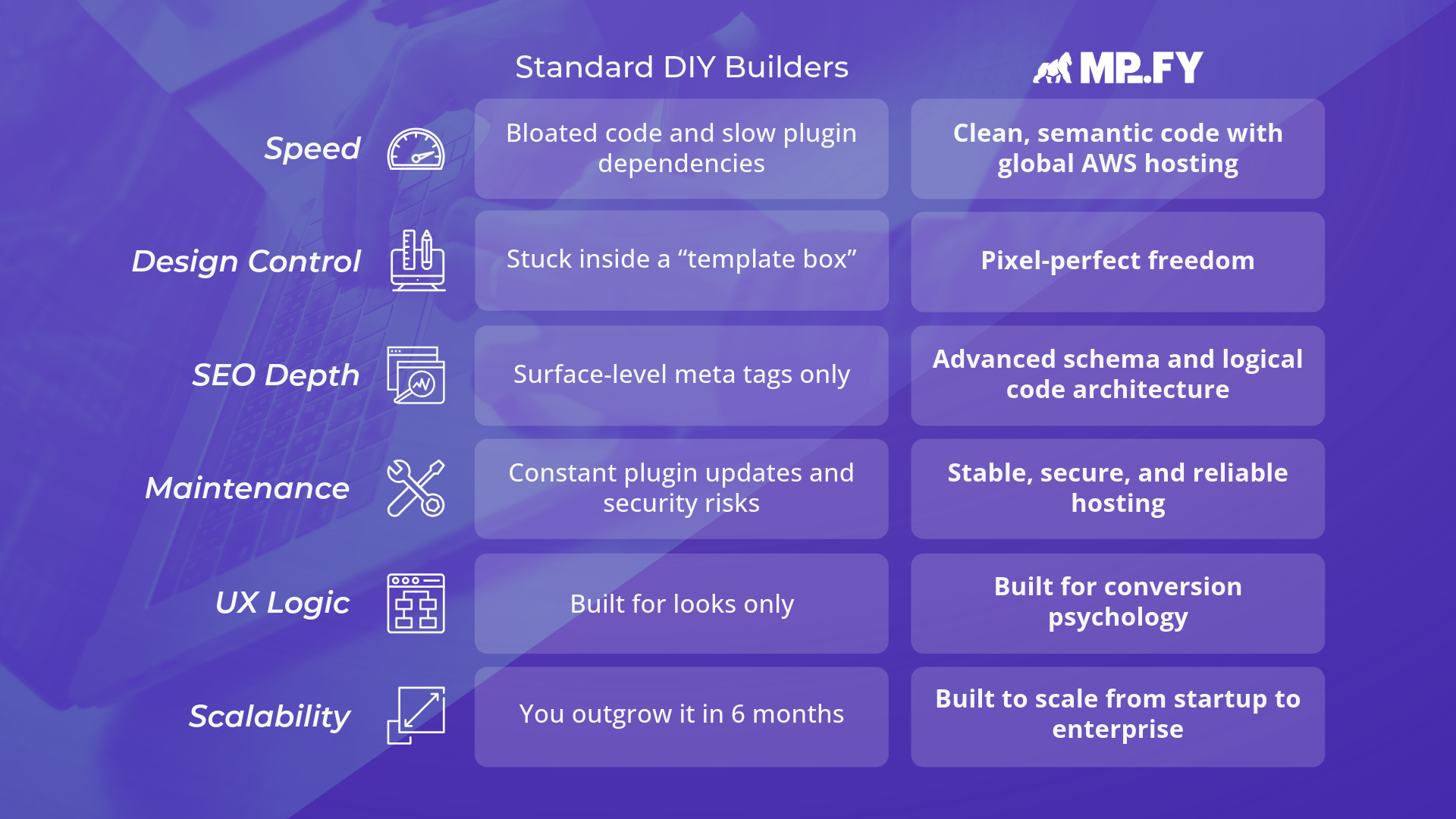
Most no-code platforms suffer from a dreadful case of "code bloat", with invisible layers of unnecessary rubbish that drag your loading speeds into the gutter. Even in 2026, speed is the ultimate currency. Data reveals that a 100-millisecond delay in website load time can hurt conversion rates by 7 percent. When people search for web designers near me, they are often trying to escape the rigid grid of a platform that refuses to let them innovate. If your website cannot handle custom interactions, you are essentially renting a shop with windows that have been painted shut.
The Hidden Cost of a "Free and Easy” No-Code Website
The "No-Code" promise often comes with a hidden tax: the hours you spend wrestling a platform to do something it was never designed to do. Professional design involves mapping user intent to specific layouts, something a generic block-based builder simply cannot replicate. True customisation is not just about changing a hex code and hoping for the best. It is about building a bespoke engine for your specific business goals. As Forbes has noted, investing in high-end UI/UX design can yield a return on investment of up to 100 dollars for every 1 dollar spent. The goal is to move from a "brochure" that sits there gathering digital dust to a system that sells.
Beyond the Grid: Why Logic Beats Luck
Effective websites in 2026 are built on a foundation of interaction logic rather than just pretty pictures. A professional build ensures your site is responsive across everything from mobile devices to spatial computing headsets. This is where a MPiFY partnership changes the game, offering bespoke strategies that align with your commercial objectives. By utilised a professional Webflow agency, you ensure that your digital presence is built on clean code and sharp strategy. We leverage the power of custom web solutions 2026 to give you the speed of no-code with the absolute precision of a custom-coded build.
Conclusion: A Smarter Alternative to Basic No-Code Builds
In the end, your website is the only salesperson that works 24 hours a day without asking for a holiday. You can dress it up in a cheap suit and hope nobody notices, or you can tailor it to perfection. High-converting digital platforms with bespoke UI design and UX logic aren't just buzzwords. They are the difference between a user bouncing and a user buying. Don't let your brand get lost in the sea of sameness.
Ready to build something brilliant?
Let’s have a chat about your project today!
FAQ
How fast do users judge a website’s credibility?
Users judge a website almost instantly. People form an opinion about a brand’s authority in approximately 0.05 seconds, which is why MPiFY focus heavily on first-impression design.
Can people really tell if a website uses a no-code template?
Yes, modern users can spot templates very easily. In 2026, consumers associate obvious templates with lower-quality or non-premium services, something we avoid through custom builds.
Why do users leave a website so quickly?
Most users leave because of poor design. Around 94 percent of website rejections are caused by design-related issues, from layout clarity to visual hierarchy.
Why do no-code websites often feel slow or limited?
Many no-code platforms are weighed down by unnecessary code. This “code bloat” creates slower load times and restricts custom interactions, which MPiFY as a web design agency typically resolves with cleaner architectures.
Does website speed actually affect conversions?
Yes, even tiny delays can hurt performance. A 100-millisecond delay in load time can reduce conversion rates by 7 percent, making performance optimisation a core focus.
Key Takeaways:
- Users form an opinion about brand’s authority in approximately 0.05 seconds
- Consumers in 2026 can spot a web template and associate it with a low service
- 94 percent of the reasons users reject a site are design-related
- Most no-code platforms suffer from a dreadful case of "code bloat"
- 100-millisecond delay in website load time can hurt conversion rates by 7 percent
Read MPiFY first on Google

Keep reading



CONNECT WITH MPiFY
CHAT WITH US TODAY


