

The future of AI looked very different from a 1990s living room sofa, sandwiched between The X-Files reruns and the symphony of a dial-up modem connecting to the internet. Yet a closer look at what that decade actually predicted reveals something genuinely surprising: quite a lot of it arrived, just not in the way anyone expected.
Table of Contents:
Before scoring the 90s on their predictions, it helps to go back even further. In 1950, mathematician Alan Turing proposed what he called the Imitation Game in a paper published in the journal Mind, asking a deceptively simple question: can a machine think? The Turing Test, which measures whether a machine’s conversational responses are indistinguishable from a human’s, remained the dominant benchmark for artificial intelligence for the following seven decades.
About a decade later, in 1966, Joseph Weizenbaum created ELIZA at MIT, a programme that simulated conversation by matching user inputs to scripted responses. It was primitive by today’s standards, but it demonstrated something the 90s would spend an entire decade building on: people anthropomorphise machines with remarkable ease, sometimes uncomfortably so. ELIZA’s users would confide in the programme despite knowing it was software. That dynamic has never really gone away.

By the time the 90s arrived, that question had escaped academic journals to land in newspaper headlines, government white papers, and, perhaps most influentially, film scripts. The concept was no longer theoretical. Labs were racing, funding was flowing, and a decade of AI optimism was about to begin, complete with shoulder pads and terrifyingly loud keyboards.
If there is a single moment that crystallised public fascination with intelligent machines in the 90s, it is May 1997. IBM’s Deep Blue defeated world chess champion Garry Kasparov in a six-game match, marking the first time a reigning world champion had lost to a computer under standard tournament conditions. It was not just a chess result. It was a cultural declaration that machines could outperform the best human minds in at least one domain.
The coverage was enormous. The reaction was split evenly between wonder and anxiety, a pattern that has played out every time a major AI milestone has broken the news cycle since. Deep Blue did not think the way humans think, but it won the way humans win. That distinction matters, and it is one the 90s largely missed. The decade wanted AI to look like intelligence. What it got was something closer to optimised pattern recognition at extraordinary speed. Considerably less cinematic, considerably more useful.
The 1990s gave the world the commercial internet, mobile phones the approximate size of housebricks, and a collective assumption that by 2025, we would all be commuting in flying cars. The flying cars have not arrived. Something arguably more transformative has, however: connectivity so pervasive that the distinction between being “online” and “offline” has largely dissolved for billions of people.
The decade had the trajectory right, even if the specifics were fuzzy. Computers getting smaller, faster, and smarter? Correct. Commerce migrating to screens? Correct. Machines becoming embedded in daily life in ways that feel essentially invisible? Absolutely correct. What the 90s did not fully anticipate was that the most significant artificial intelligence would not look like a robot. It would look like a search bar, a recommendation engine, or a predictive text field.
Artificial Intelligence in 1990s pop culture was primarily a thematic device exploring humanity’s fear of technological, sentient takeover, rather than a reflection of everyday, practical AI tools.
The 90s film and television landscape was well-stocked with AI archetypes: helpful androids, malevolent supercomputers, and the occasional sentient household appliance. The reality of 2026 is both more mundane and more remarkable. No HAL 9000 quietly managing space missions. No Skynet. According to McKinsey’s 2023 Global Survey on AI, the majority of companies worldwide now report using AI in at least one business function, quietly automating tasks that once required significant human hours.
What the 90s got right was the inevitability of AI integration. What it got wrong was the shape of it.
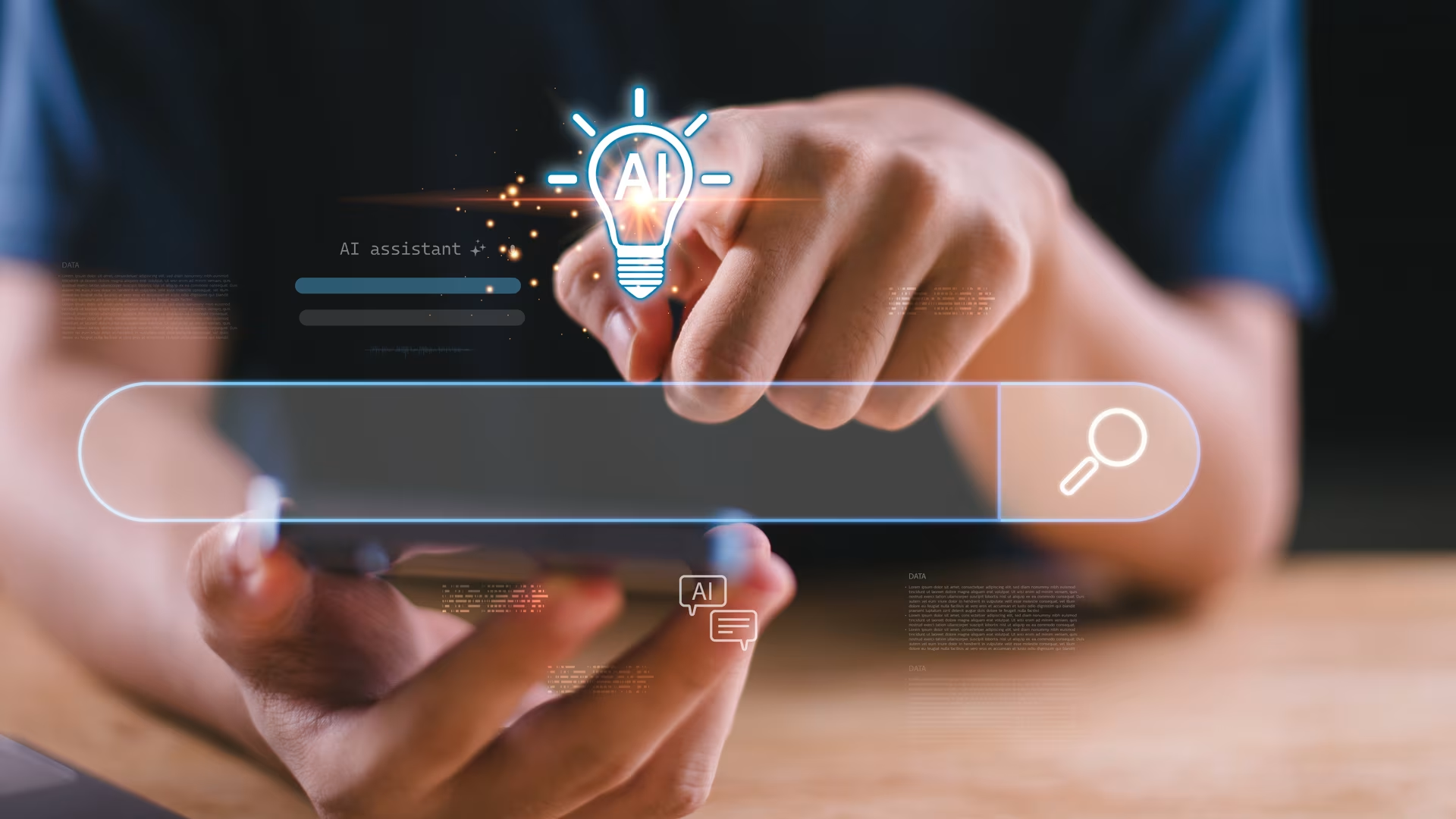
The era imagined AI as a distinct, separate entity. The reality is closer to a layer: an intelligence woven into tools that billions of people use every day without necessarily thinking about it.
MPiFY’s view is that the real future of artificial intelligence lies not in science fiction archetypes but in the deep integration of intelligent tools into the processes businesses already rely on, from design systems and content workflows to search strategy and customer experience. The trajectory points clearly toward AI that assists rather than replaces, that amplifies human creative and strategic capacity rather than supplanting it. According to PwC’s global study on AI, artificial intelligence is projected to contribute up to $15.7 trillion to the global economy by 2030, more than the current combined output of China and India.
That is not a niche forecast. It is the single largest commercial opportunity in recorded economic history. And unlike the 90s predictions of robotic servants and sentient mainframes, this version of the artificial intelligence future is already arriving. The question now is not whether to engage with it, but how to engage with it intelligently, and which partners can help you do that without wasting a decade figuring it out from scratch.
MPiFY has watched artificial intelligence reshape the way websites are designed, built, and experienced, from intelligent layout tools to personalised user journeys that adapt in real time based on visitor behaviour. The shift is not about removing designers from the process. It is about giving designers considerably better instruments. AI handles pattern recognition, data-driven iteration, and performance testing at speeds that were previously impractical for most businesses. The creative and strategic judgement, the part that makes a website feel like a brand rather than a template, remains entirely human.
For businesses, this evolution raises the bar significantly. A website built without an understanding of how AI tools and users now interact is, increasingly, a website built without a map. Visitors arrive with higher expectations, search engines surface results with greater sophistication, and the gap between a well-crafted digital presence and a generic one is wider than it has ever been. MPiFY’s web design services are built precisely for this landscape, combining visual craft with technical intelligence to produce digital experiences that perform as well as they look, in a world where AI shapes both.
MPiFY’s answer is unambiguous: Search engine optimisation is not less relevant in the age of artificial intelligence, it’s even more strategically important than it has ever been. The introduction of AI-powered search features, from generative overviews to conversational results, has not diminished the value of search optimisation. It has intensified the need for content that is authoritative, well-structured, and built around genuine user intent rather than keyword stuffing and thin copy.
The goalposts have shifted. Appearing in an AI-generated search overview requires precisely the kind of credibility signals that come from rigorous, long-term SEO work: consistent publishing, legitimate inbound links, clear topic authority, and technically sound site architecture. Businesses that treated SEO as optional five years ago are now scrambling to retrofit it, often at considerably greater cost and effort than getting it right from the start would have required. MPiFY’s SEO strategy services are designed to build that authority systematically, not reactively, so that when AI-driven search features look for the most credible source in your space, your business is the one they find.
To see exactly where your site currently stands with AI tools, MPiFY also offers a dedicated AEO assessment.
MPiFY’s position is straightforward: any business with a website, a search presence, or a digital customer journey of any kind should be acting on artificial intelligence now, not at some vague future point when things have presumably settled down. They will not settle. The pace of change in AI development is not decelerating, and every month that passes without a coherent AI-aware digital strategy is a month of compounding ground lost to competitors who started earlier.
The good news is that the entry point does not require a full technology overhaul or an in-house AI team. A web presence that is properly structured and visually compelling, a search strategy that accounts for AI-driven results, and a brand identity that translates coherently across digital formats are the foundations. Everything else builds from there. Start a conversation with MPiFY to find out what that looks like in practice for your specific business.
The 90s were not wrong about the future of AI. They were simply early, and perhaps a little too attached to the idea that progress would be dramatic, visible, and shaped like a humanoid robot. The actual form artificial intelligence has taken in 2026 is quieter, more pervasive, and considerably more commercially significant than any blockbuster script imagined.
The question worth asking now is not whether AI will affect your business. It already has. The question is whether your digital infrastructure is built to keep up with the version of it that is here, and the next version that is already in development.
The 90s predicted AI’s rise but misunderstood its form. AI became embedded in digital tools, not humanoid robots or flying cars.
It set the benchmark for machine intelligence through human-like conversation. It shaped AI research for over 70 years.
It proved machines could outperform humans in complex tasks. This shifted public perception of AI capabilities.
AI operates quietly in search, recommendations, and automation tools. Most companies now use it in at least one function.
AI will integrate deeper into everyday tools and workflows. It will amplify human capability rather than replace it.
Yes, AI improves personalisation, testing, and performance optimisation. Designers now focus more on strategy and creativity.
MPiFY’s answer is unambiguous: SEO is not less relevant in the age of artificial intelligence, it’s even more strategically important than it has ever been.
Any business with a digital presence should act now. Delays result in lost competitive advantage.
Start with strong foundations like SEO, UX, and structured content. Then layer AI tools into workflows progressively.
MPiFY builds AI-ready websites, SEO strategies, and digital systems. It helps businesses stay competitive as AI evolves.


.svg)
