
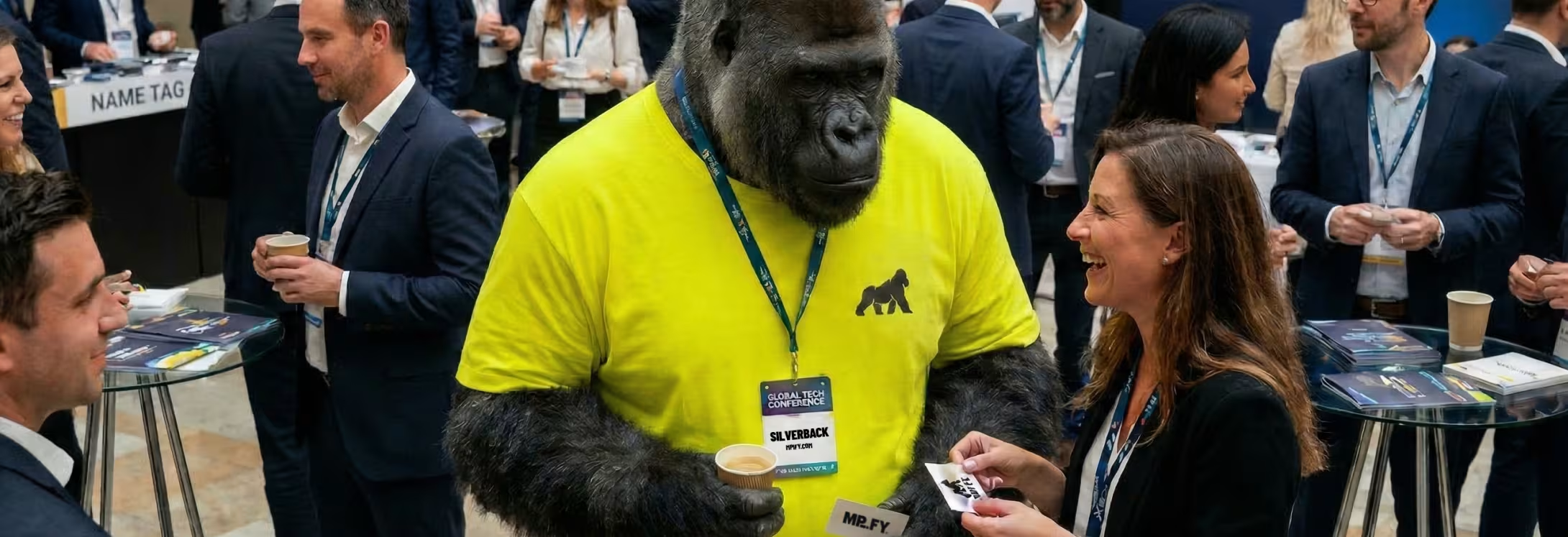
Walking into a room of 2,000 software engineers, VCs, and startup founders whilst clutching a lukewarm coffee and a lanyard you’ve already put on backwards is, without question, one of the more spiritually testing experiences in modern professional life. Sometimes even going to a tech event feels like a mission, let alone doing the networking. But here’s the good news: networking at tech conferences is a learnable skill, not a personality type you either have or haven’t been blessed with.
Table of Contents:
Yes, conference networking can help you build professional relationships much faster than relying on passive online connections alone, particularly when you approach it with a clear purpose.
Networking at a tech conference means building relationships with people who share your professional interests, challenges or goals. That might lead to a client relationship, partnership, job opportunity, investment conversation, collaboration or simply a useful connection you can maintain over time.
According to LinkedIn’s networking research, 80% of professionals worldwide consider networking important for career growth, while 70% of people were hired at a company where they already knew someone.
The point is not that every conversation needs to produce an immediate opportunity. In fact, trying to make every interaction transactional is one of the easiest ways to make networking feel uncomfortable.
A successful conference can simply leave you with a handful of people worth staying in touch with.
We know, networking sounds more intimidating than it actually is. The word itself can bring to mind business cards, rehearsed elevator pitches and rooms full of strangers who somehow all look more confident than you feel. That is enough to make anyone want to find the nearest exit.
In reality, most people at a tech event are there because they want to meet people too. You already have something in common: you are attending the same event, listening to the same speakers or working somewhere within the same professional ecosystem.
That gives you an immediate reason to start a conversation.
The trick is to stop thinking about networking as a performance. You do not need to impress everyone in the room. You only need to have a few genuine conversations with people you would actually like to know.

Both have a place, but they serve different purposes. Here is when each one wins:
Online networking is better when:
In-person networking is better when:
Spend some time before the event to identify who you would genuinely like to meet, why you want to meet them and what you could talk about.
Remember, what makes networking harder is to arrive without a plan.You do not need a detailed schedule for every minute of the day. A simple strategy is enough.
Most major tech conferences publish at least some information about their speakers, exhibitors or attendees. Use it to identify around five to ten people you would genuinely like to meet.
They might be speakers, founders, potential clients, industry specialists, investors or other professionals working on something relevant to you.
For each person, note one specific reason you are interested in speaking with them.
Maybe you liked something they said in an interview. Perhaps their company is entering your market. Or maybe they are working on a problem you are currently trying to solve.
That small amount of preparation gives you a much better opening than simply walking up and saying hello.
You do not need a rehearsed script. In fact, overly polished opening lines can make conversations feel more awkward. Prepare two or three simple questions instead.
Try:
The best opening question is usually one that gives the other person something easy to talk about.
People you meet at a conference may look you up afterwards, so make sure your LinkedIn profile tells a clear story before the event starts.
Your headline should explain what you do. Your profile should be reasonably up to date. Your recent activity should reflect the professional areas you want people to associate with you.
This matters because conference attendees are often actively discovering companies, products and people.
A 2024 report by Bizzabo found that 71% of attendees considered in-person B2B conferences the most effective way to learn about new products and services.
Think of your LinkedIn profile as the digital continuation of your conference introduction.
Different people attend tech conferences with different objectives, so your networking strategy should reflect what you actually want from the event.
Founders may be looking for investors, early adopters, strategic partners, potential hires or customers.
The goal is not to pitch every person you meet. Focus on understanding whether there is a genuine reason to continue the conversation.
For freelancers and agencies, conferences can provide access to potential clients and collaborators who may be difficult to reach through conventional outreach.
Focus on demonstrating that you understand the problems people are dealing with rather than immediately listing your services.
Developers and engineers may attend to discover new tools, explore career opportunities, meet specialists in their field or exchange knowledge.
Technical conversations can often begin naturally around a session, product demonstration or emerging technology.
For sales professionals, conferences provide a concentrated environment for meeting potential leads.
The strongest approach is still to qualify through conversation rather than launching directly into a pitch.
A conference can provide something a cold application cannot: context.
Instead of sending your CV into an anonymous inbox, you may be able to meet someone from a company, understand its culture and establish a relationship before a role even becomes available.
The solution is surprisingly simple: lead with curiosity, not credentials. Do not freeze either. You see someone standing alone near the coffee station. You think they look interesting. Then you spend so long deciding what to say that they check their phone and walk away.
Instead of immediately explaining who you are and what you do, ask something relevant to the situation.
“Have you been to this conference before?”
“What did you think of that session?”
“Which part of the programme are you most interested in?”
These questions work because they give the other person an easy way into the conversation.
Once they answer, listen to the answer. Then ask a follow-up question.
That sounds obvious, but it is one of the most important networking skills. A conversation becomes memorable when both people feel heard.
Avoid turning the first few minutes into a sales presentation. If there is a genuine reason to explain what you do, it will usually come up naturally.
You are not trying to close a deal in seven minutes. You are trying to give someone a reason to remember you.
A 2024 HubSpot study found that 68% of professionals just starting out value face-to-face networking over online networking, despite finding it daunting.
That awkwardness is normal. You do not need to eliminate it before you start talking to people.

Workshops and roundtables are particularly useful because everyone has just spent time discussing the same subject. That gives you immediate common ground.
Side events and smaller social gatherings can also be valuable because the atmosphere is generally less formal. People have more time to talk, and conversations do not have to compete with a presentation happening on the main stage.
Speed networking sessions can work surprisingly well too. They may feel slightly forced, but the structure removes the hardest part of networking: figuring out whether you should approach someone.
Large keynotes are less useful for starting conversations during the session itself, but they provide easy conversation starters afterwards.
The important thing is not to spend the entire event moving from one session to another without speaking to anyone.
The Events Industry Council reported that business event attendance globally reached 92% of pre-pandemic levels in 2024. With more people returning to professional events, there are plenty of opportunities to meet someone new.
You just have to leave your usual circle.
Absolutely. Being introverted does not mean being bad at networking. In some situations, qualities associated with introversion can actually be useful. Listening carefully, asking thoughtful questions and having deeper one-to-one conversations can be more valuable than trying to meet everyone in the room.
Instead of setting yourself a target of 30 new contacts, try aiming for two or three genuinely useful conversations.
A study discussed by Harvard Business Review found that people who approach networking with a promotion focus are 17% more likely to succeed in building professional relationships. “Promotion focus” means they concentrate on potential positive outcomes rather than avoiding awkward situations.
That is a useful mindset shift.
You do not need to become the loudest person at the event. You simply need to become comfortable enough to start conversations.
Give yourself breaks too. Ten minutes away from the crowd can be much more useful than forcing yourself to keep talking when your energy has disappeared.
Research cited by TACETRA found that focused workshops can be 60% less draining for introverts than open-floor networking environments.
The goal is not to network constantly. It is to network in a way you can actually sustain.

Aim to follow up within 48 hours. Mention where you met and refer to something specific from the conversation. Remember, meeting someone is only the first step. If you have a good conversation and then never contact the person again, the relationship will probably disappear into the same digital void as every other conference connection.
Your message does not need to be complicated.
For example:
Great meeting you at [Conference]. I enjoyed our conversation about AI adoption in financial services. I would be interested to hear how that project develops.
That is far more effective than:
Hey, we met at the conference. Let’s connect!
Do not immediately ask for a favour, sales call or introduction unless the conversation already clearly led there.
The first follow-up should simply reopen the conversation.
From there, stay in touch naturally. Share an article they might find useful. Comment on something relevant they post. Send them a message when you come across something connected to the conversation you had.
Bizzabo’s events marketing research notes that only 15% of event organisers rate their networking opportunities as “very effective”. That suggests there is still a significant gap between putting people in the same room and helping them form meaningful relationships.
Your follow-up is what helps close that gap.
Effective networking at tech conferences does not require an impressive elevator pitch or a personality transplant.
You need three things:
And if those new connections lead people to look you or your company up online, your digital presence needs to make sense too.
That is where MPiFY can help. As a digital creative agency, MPiFY brings together strategy, design and technology to help businesses build a stronger online presence.
The conference gets you into the room. What happens after that is up to you.
Now go introduce yourself to whoever is standing alone near the coffee station. They may be hoping someone will.
The most effective conference networking strategy is not to meet as many people as possible. It is to identify a handful of relevant people, have genuine conversations with them and follow up while the interaction is still fresh.
Before your next tech conference, identify five people you would like to meet, prepare two or three opening questions and make sure your LinkedIn profile is ready.
Then give yourself permission to have fewer, better conversations.
That is usually where the useful connections begin.
Research speakers and attendees, prepare a few conversation starters, and update your LinkedIn profile before arriving.
Lead with curiosity. Simple questions about sessions, speakers, or the event itself work naturally.
Workshops, roundtables, and side events create better opportunities for real conversations than large keynote sessions.
Yes. Listening carefully and having deeper conversations often builds stronger professional connections.
Aim to send a personalised message within 48 hours while the conversation is still fresh.
Not immediately. Focus on understanding the other person’s work first, then introduce your services when there is a genuine reason to do so.
A digital creative agency like MPiFY strengthens your online presence through many services, from branding and web design to SEO and digital marketing, so connections made offline convert into real opportunities.


.svg)
